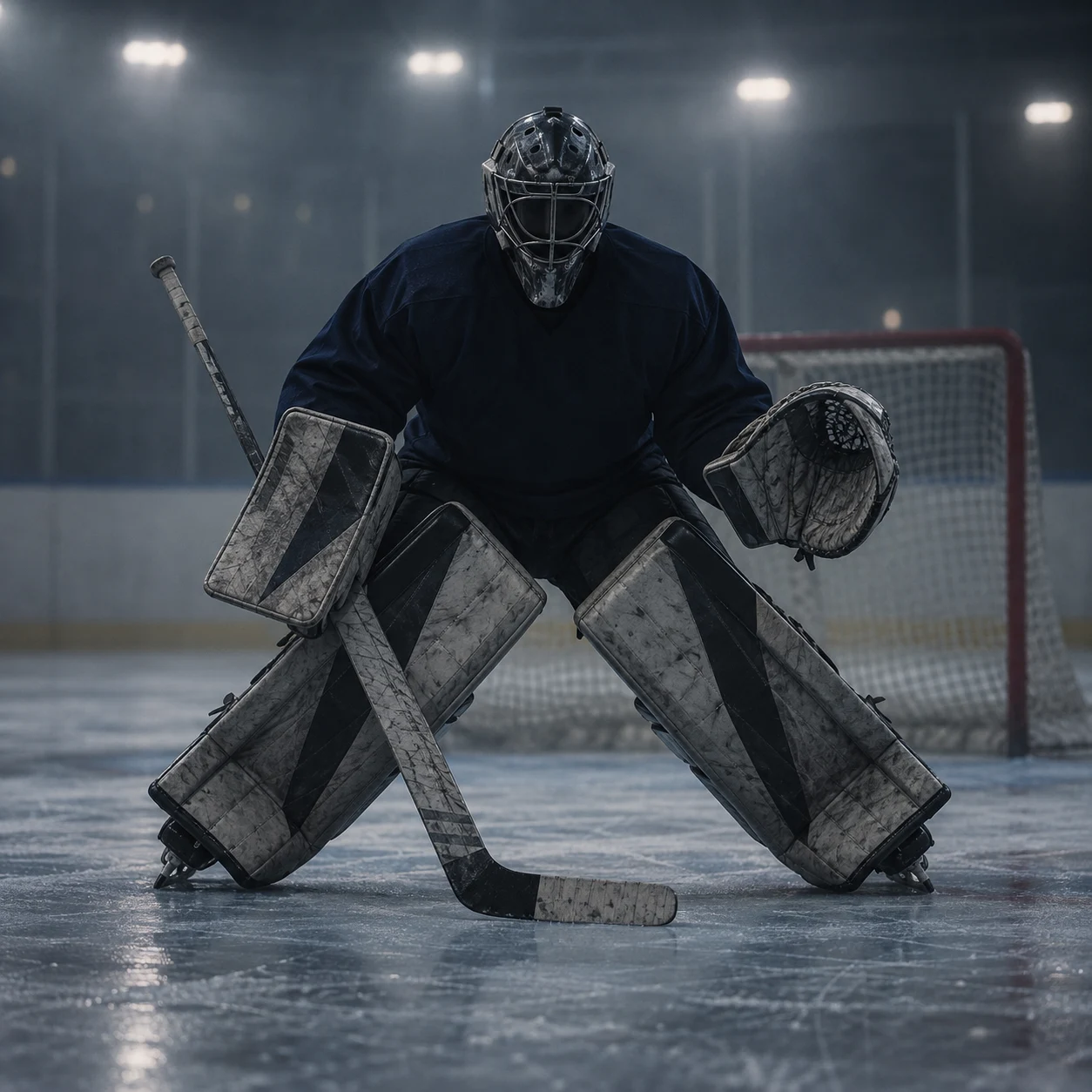
Ryan’s technical case begins with patience on the shooter and the ability to close the lower net quickly. Published evaluation identifies sharp reactions, strong leg drive and pads that settle flush to the ice, helping him keep the five-hole covered and limit immediate rebound opportunities. His composure in high-school competition is particularly meaningful for a 2011-born goaltender facing older players. These are specific parts of the assessment, beyond a general claim of good crease movement.
Ryan’s published 2025–26 record for St. Thomas Academy lists 23 appearances: 1.34 GAA, .949 save percentage, 6 shutouts. For Ryan, that line anchors the season comparison with St. Thomas Academy; technique and competition remain part of the ranking. Across that sample, 94.9% of recorded shots were stopped.
WHY HE IS RANKED #1
WHY THIS PLACEMENT
Ryan’s #1 placement has a strong performance foundation: 23 games, a 1.34 GAA, .949 save percentage and six shutouts while playing Minnesota high-school hockey as an underage goaltender. His age relative to that competition adds weight to the qualifying workload. Published evaluation identifies patient shooter reads, quick reactions and effective low-net sealing, giving the statistical results a technical foundation. A scout-and-media committee’s statewide Goalie of the Year award and Calgary’s decision to trade up for him in the WHL draft add independent recognition. AHP places the combined case of sustained stopping performance, older competition and technical composure first in this class; different team environments prevent treating save percentages as directly interchangeable.
The next step is maintaining his patient reads and low-net coverage as attackers move the puck laterally faster. Consistent recoveries and controlled rebounds under layered traffic will test whether the same composure carries into a larger role against stronger competition.
SCOUTING BREAKDOWN
Crease Toolkit
Ryan’s technical case begins with patience on the shooter and the ability to close the lower net quickly. Published evaluation identifies sharp reactions, strong leg drive and pads that settle flush to the ice, helping him keep the five-hole covered and limit immediate rebound opportunities. His composure in high-school competition is particularly meaningful for a 2011-born goaltender facing older players. These are specific parts of the assessment, beyond a general claim of good crease movement.
Performance in Context
Ryan’s published 2025–26 record for St. Thomas Academy lists 23 appearances: 1.34 GAA, .949 save percentage, 6 shutouts. For Ryan, that line anchors the season comparison with St. Thomas Academy; technique and competition remain part of the ranking. Across that sample, 94.9% of recorded shots were stopped.
Development Focus
The next step is maintaining his patient reads and low-net coverage as attackers move the puck laterally faster. Consistent recoveries and controlled rebounds under layered traffic will test whether the same composure carries into a larger role against stronger competition.
2025–26 STATISTICS
St. Thomas Academy · USHS-MN · 2025–26
23Games played
1.34GAA
.949Save %
6Shutouts
Season statistics · 23 GP; qualifying minimum 15 GP. One competition record; overlapping schedules are not combined.
Following the puck through passes, shots and traffic to stay connected to the play.
Crease movement
Moving within the goal crease to adjust position as the attack changes.
Depth management
Choosing how far out from the goal line to play, balancing net coverage with recovery time.
Rebound management
Absorbing a shot or directing the saved puck away from an immediate follow-up chance.
Second-save structure
Regaining a balanced, ready position after the first save to handle another attempt.
Post exits
Moving away from the goalpost into position for a new shooting threat.
Supporting scouting coverage
Player identity and season record
Research last reviewed: October 5, 2026. Birthplace refers to the publicly listed U.S. state of birth. Assessment combines scouting observations, technical assessment and verified performance context.